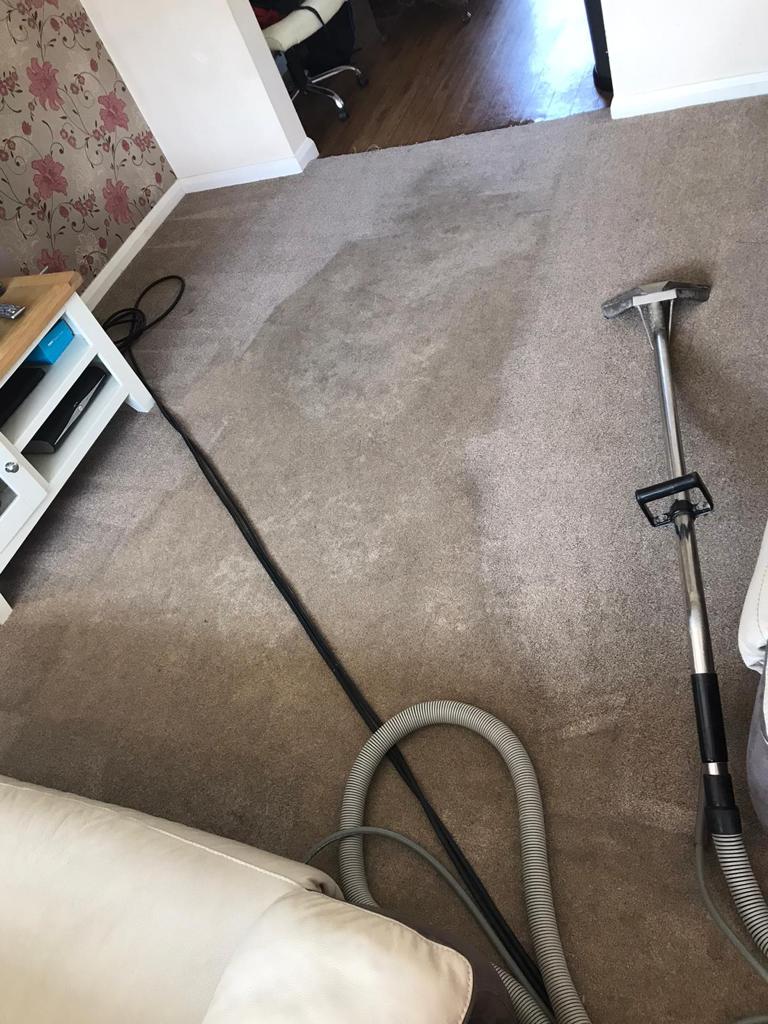
Commercial carpets experience very different conditions from those in most homes. In busy workplaces, the same areas may be walked over hundreds of times each day, with dirt, moisture and fine particles continually transferred from footwear into the carpet pile. Entrances, corridors, reception areas, meeting spaces and routes between workstations often experience the greatest concentration of this wear.
Routine vacuuming remains essential because it removes a large proportion of loose surface soil. However, high-traffic carpets can also retain fine particles, sticky residues and deeply embedded contamination that ordinary vacuuming does not fully remove. Over time, this can make the carpet look dull, flatten the pile and create visible traffic lanes even when regular cleaning is already taking place.
For businesses in Ashford, Kent, professional commercial carpet cleaning can help address this deeper build-up. The objective is not simply to make the carpet look cleaner for a short period. A properly planned clean should consider carpet construction, levels of soiling, traffic patterns, stains and the condition of the fibres so that the treatment is appropriate for the workplace and the carpet itself.
Why Do High-Traffic Commercial Carpets Need More Than Routine Vacuuming?
Vacuuming is one of the most important parts of carpet maintenance, but it is designed primarily to remove loose dry soil.
Commercial carpet cleaning addresses a different level of contamination.
In busy workplaces, repeated foot traffic can work soil deeper into the pile, while spills and residues can bind dirt to the fibres. Once this happens, the carpet may continue to look tired even after thorough vacuuming.
Foot Traffic Continuously Introduces Soil
Every person entering a workplace can bring small amounts of outside contamination on their footwear.
Much of this is difficult to see individually.
Over the course of a working day, however, these small amounts accumulate.
Fine dust, grit and general soil can gradually move from entrance areas through frequently used internal routes.
The result is often a clear difference between heavily walked areas and sections beneath furniture or close to walls.
Entrance Areas Usually Receive the Heaviest Soiling
The entrance is one of the most demanding areas for commercial carpeting.
Footwear can bring in moisture and particles before people have moved far into the building.
Even where entrance mats are used, some contamination will continue beyond them.
This is why the carpet immediately inside entrances can often become darker or more compacted than surrounding areas.
Professional cleaning can target this concentrated build-up rather than treating every part of the carpet as though it receives identical use.
Corridors Can Develop Visible Traffic Lanes
Corridors concentrate movement into relatively narrow routes.
Unlike an open room where people may walk in many directions, corridor traffic repeatedly passes over the same strip of carpet.
Over time, this can create clearly defined traffic lanes.
The carpet may appear darker in these areas because of embedded soil, although some visual difference can also result from wear and pile distortion.
Professional assessment helps distinguish between removable contamination and permanent changes to the fibres.
Reception Areas Influence the Appearance of the Workplace
Reception spaces often experience high levels of footfall while also forming one of the first areas visitors see.
A carpet can therefore still be functional while looking noticeably dull or marked in this location.
Commercial carpet cleaning can help restore a cleaner and more consistent appearance where the problem is caused by soil and residues.
It is important, however, to recognise that cleaning cannot reverse permanent fibre wear.
A professional service should make this distinction rather than promising that every visible mark will disappear completely.
Fine Grit Can Become Embedded Deep Within the Pile
Some carpet soil consists of very small abrasive particles.
These can work their way down between fibres and may not be fully removed by everyday vacuuming.
Repeated foot traffic can then continue moving these particles within the carpet.
Effective commercial carpet cleaning therefore usually begins with thorough dry soil removal before wet cleaning methods are introduced.
Removing as much dry contamination as possible first helps the later cleaning stages work more effectively.
Soil Can Change the Way Carpet Reflects Light
A commercial carpet may appear darker even when there is no single obvious stain.
This can happen because fine contamination coats the fibres and changes how light reflects from the pile.
Heavily used sections can therefore look noticeably different from areas underneath desks or furniture.
Deep cleaning can often improve this visual difference where embedded soil is responsible.
Where the fibres themselves have become worn, however, some variation may remain after cleaning.
Carpet Can Look Clean While Still Containing Embedded Soil
Dark colours and patterned commercial carpets can sometimes conceal contamination surprisingly well.
The surface may appear acceptable from standing height even though significant dry soil remains deeper in the pile.
This is one reason visual appearance alone is not always a reliable guide to carpet cleanliness.
Traffic levels, time since the previous professional clean and the amount of daily contamination should also be considered.
Repeated Footfall Can Compact the Carpet Pile
Carpet fibres are repeatedly compressed under footwear and furniture.
In high-traffic areas, this occurs many times each day.
Embedded soil and residues can make the effect more noticeable because the fibres are less able to separate freely.
Professional cleaning may help improve the texture where soil is contributing to the flattened appearance.
It cannot reconstruct fibres that have been permanently worn or damaged through long-term use.
Vacuuming Cannot Remove Every Type of Contamination
Dry vacuuming is highly valuable but has limitations.
It is best suited to loose soil.
Sticky contamination, oily residues and some spills can remain attached to carpet fibres even after repeated vacuuming.
These residues can also attract further dirt, causing cleaned areas to become dull again relatively quickly.
Professional carpet cleaning introduces appropriate pre-treatment and extraction methods designed to address contamination that vacuuming alone cannot remove.
Residues Can Cause Rapid Re-Soiling
A carpet can sometimes become dirty again unusually quickly after an unsuitable cleaning attempt.
One possible reason is detergent residue remaining within the fibres.
Sticky residues can attract soil as people walk across the carpet.
This can create the impression that the original stain or traffic mark has returned.
Professional carpet cleaning should therefore include careful control of cleaning products and sufficient rinsing or extraction to minimise unwanted residue.
Using More Cleaning Product Is Not Necessarily Better
A common mistake is to assume that heavily soiled carpet requires a much stronger concentration of cleaning solution.
This can be counterproductive.
Excess product can be more difficult to remove completely and may contribute to residue within the carpet.
Professional cleaning is based on using appropriate products and methods for the specific carpet and contamination rather than simply applying more chemical.
Heavy Water Use Is Not Automatically More Effective
Similarly, soaking a carpet does not necessarily make it cleaner.
Commercial carpets can vary considerably in their fibre type, backing and construction.
Controlled moisture is important.
Using more water than required can extend drying times and may not improve soil removal.
Professional cleaning aims to balance effective treatment with suitable moisture control for the carpet being cleaned.
Spills Behave Differently From General Soil
Workplace carpets can experience coffee, tea, food, soft drinks and other spills.
These are different from ordinary dry soil.
A spill can leave colour, sugar, oils or other residues within the carpet.
If those residues remain, they can attract more dirt and create a darker area.
Professional treatment considers the nature of the contamination rather than treating every mark with the same cleaning method.
Old Stains Can Be More Difficult to Remove
A stain that has remained in a commercial carpet for a long time can become more difficult to treat than a recent spill.
Cleaning products previously applied to the area can also influence the result.
In some cases, what appears to be a stain may actually be permanent fibre discolouration.
Professional assessment helps establish what improvement is realistically achievable before treatment begins.
Reappearing Marks Can Have Several Causes
A mark that seems to disappear and then returns may have more than one explanation.
Residue can attract fresh soil.
Contamination may remain deeper in the carpet construction.
Alternatively, the visible difference may be caused partly by fibre wear rather than removable dirt.
A professional cleaner can assess these possibilities instead of repeatedly applying product to the surface.
High-Traffic Areas Need Targeted Pre-Treatment
Commercial carpets rarely become equally dirty across the entire floor.
Entrances and main walking routes usually require more attention than low-use perimeter areas.
Targeted pre-treatment allows cleaning to respond to these differences.
This can help loosen accumulated soil before extraction rather than using the same treatment intensity across every section.
Agitation Can Help Release Embedded Soil
Depending on the carpet and chosen cleaning method, controlled agitation can assist the cleaning process.
Its purpose is to work suitable cleaning solution through heavily soiled fibres and help separate contamination.
This should be carried out appropriately for the carpet construction.
Aggressive treatment is not automatically better and can be unnecessary where lighter methods are suitable.
Extraction Removes Loosened Contamination
Once soil and residues have been loosened, they need to be removed from the carpet.
Extraction is an important part of many professional commercial carpet cleaning processes because it takes away suspended contamination rather than merely redistributing it within the pile.
Effective extraction also contributes to residue control.
The cleaning process should therefore be considered as a sequence rather than relying on one stage alone.
Dry Soil Removal Should Usually Come Before Wet Cleaning
Applying moisture to a carpet that still contains substantial loose dry soil can make the cleaning process less efficient.
For this reason, thorough vacuuming or other appropriate dry soil removal is usually an important preparation stage.
This reduces the amount of loose contamination before pre-treatment begins.
In high-traffic commercial areas, this preparation can make a considerable difference because large quantities of fine particulate soil may have accumulated.
Commercial Carpet Cleaning Can Improve Overall Appearance
One of the most noticeable benefits of professional cleaning is improved visual consistency.
Traffic lanes can become less prominent where embedded soil is responsible for the colour difference.
General dullness can also improve once contamination has been removed from the fibres.
This can help the carpet present a cleaner appearance across the workplace without implying that professional cleaning can reverse every form of wear.
Cleaner Carpets Can Support a More Presentable Working Environment
Flooring occupies a substantial visible area within many commercial interiors.
When carpets become heavily marked, dull or stained, the whole space can appear less well maintained.
Cleaning can therefore contribute to the presentation of offices, reception spaces and other work areas.
This is particularly relevant in areas regularly used by visitors, customers or staff.
Commercial Cleaning Helps Manage Repeated Workplace Contamination
The value of professional cleaning is not limited to occasional stain removal.
High-traffic workplaces generate continual soiling.
A structured cleaning approach helps address the accumulation produced by this daily use.
Routine vacuuming manages loose contamination between professional cleans, while deeper cleaning periodically addresses material that ordinary maintenance has not removed.
The two processes therefore complement each other rather than compete.
Traffic Patterns Should Influence the Cleaning Plan
A useful commercial cleaning plan reflects how the building is actually used.
An entrance may need more intensive attention than a lightly used meeting room.
The route between the entrance and reception may become soiled faster than spaces behind desks.
Recognising these patterns allows cleaning to focus on the sections that need it most.
This is more effective than assuming the entire carpet deteriorates uniformly.
Furniture Can Reveal How Much the Carpet Has Changed
One useful indication of carpet condition is the contrast between exposed areas and sections protected by furniture.
When desks, cabinets or other items are moved, the carpet underneath may look noticeably brighter.
This can demonstrate how much soil and wear have affected the exposed floor.
Professional cleaning may reduce the difference where contamination is responsible, although permanent changes caused by use can remain.
Colour Difference Is Not Always Dirt
This distinction is important.
A darker traffic lane may contain embedded soil, but long-term abrasion can also alter the carpet fibres.
Once fibres have physically worn, cleaning cannot restore material that is no longer present.
A professional carpet cleaner should identify where cleaning is likely to improve the appearance and where visible wear may remain afterwards.
Professional Cleaning Can Help Preserve Carpet Condition
Removing embedded soil is useful not only for appearance.
Fine particulate contamination can remain within the pile and continue to be disturbed by foot traffic.
A structured maintenance programme that includes professional cleaning helps prevent excessive accumulation.
The objective is to maintain the carpet appropriately throughout its use rather than waiting until it looks severely soiled.
Waiting Until the Carpet Looks Very Dirty Is Not Always Ideal
By the time a commercial carpet appears heavily soiled, contamination may already be deeply embedded.
High-traffic areas can deteriorate gradually, making the change difficult to notice from day to day.
Scheduled assessment and cleaning can address build-up before the visual difference becomes severe.
The appropriate frequency should reflect actual traffic and soiling rather than relying on a single timetable for every workplace.
Different Workplaces Create Different Cleaning Demands
A commercial carpet does not experience the same conditions in every building.
The amount of footfall, layout, entrance arrangements, type of work and likelihood of spills can all influence soiling.
A quiet office and a workplace with constant visitor movement may therefore require different cleaning approaches.
Professional assessment helps match the process to how the carpet is actually used.
Carpet Construction Should Influence the Cleaning Method
Commercial carpeting is available in different fibre types, pile structures and backing systems.
These characteristics affect how the carpet should be treated.
A cleaning method suitable for one carpet may not be ideal for another.
Professional commercial carpet cleaning should therefore begin by identifying the carpet characteristics rather than assuming that every commercial floor can be cleaned identically.
Fibre Type Can Influence Stain Treatment
Different carpet fibres can respond differently to moisture, cleaning products and staining.
This is particularly important when dealing with localised marks.
The cleaner needs to consider the fibre and contamination before selecting an appropriate treatment.
This reduces reliance on aggressive general-purpose products that may not suit the carpet.
Commercial Carpet Tiles Need Appropriate Cleaning Too
Many workplaces use carpet tiles because they are practical for commercial interiors.
These surfaces still accumulate embedded soil and traffic marks.
Cleaning needs to account for their construction and the way individual tiles form the overall floor.
High-use routes can become noticeably different from surrounding sections if soil is allowed to build up.
Office Chairs Can Create Concentrated Wear and Soiling
Areas around desks can experience repeated movement from chairs and footwear.
This can create localised soil patterns even if the wider office receives relatively moderate footfall.
Cleaning should therefore consider activity around individual workstations as well as main circulation routes.
These concentrated areas can require different attention from open floor sections.
Meeting Rooms Can Develop Their Own Soil Patterns
Meeting rooms may not be occupied continuously, but repeated use can still create predictable traffic patterns.
Chair positions, doorways and routes around tables often experience concentrated foot movement.
Food and drink can also introduce additional contamination.
Professional cleaning can address these localised patterns while considering the condition of the surrounding carpet.
Break Areas Can Present Different Cleaning Challenges
Where food and drinks are regularly carried through carpeted areas, spills and sticky residues can become more common.
These residues can attract soil if they are not fully removed.
Cleaning in these areas may therefore require more attention to spots and contamination than a standard walkway.
The appropriate treatment depends on what has entered the carpet and how long it has been present.
Commercial Carpets Can Retain Odours
Carpet fibres can sometimes retain odours associated with spills or repeated contamination.
Simply applying fragrance does not remove the source.
Professional cleaning should focus on removing the material contributing to the odour wherever possible.
The extent of improvement can depend on how deeply the contamination has travelled into the carpet construction.
Odour Problems Can Extend Below the Visible Pile
Not every odour originates only from the surface fibres.
Some contamination can reach the backing or materials beneath the carpet.
This can make complete removal more difficult.
Professional assessment can help establish whether cleaning the pile is likely to address the issue or whether the contamination appears to extend deeper.
It is better to set realistic expectations than to promise complete odour removal in every situation.
Spot Cleaning Between Professional Cleans Can Be Useful
Individual spills should not necessarily be left until the next full carpet clean.
Prompt attention can reduce the chance of residues becoming more difficult to remove.
However, unsuitable products or excessive scrubbing can sometimes create their own problems.
A sensible maintenance approach combines appropriate day-to-day care with periodic professional cleaning.
Scrubbing a Stain Aggressively Can Make the Area Look Worse
Strong physical rubbing can distort carpet fibres.
This can create a visible patch even if some of the original contamination has been removed.
The affected area may then reflect light differently from the surrounding pile.
Professional spot treatment aims to work on the contamination without unnecessarily damaging the carpet texture.
Carpet Cleaning Should Address Soil, Not Just Add Fragrance
A carpet that smells fresher is not necessarily cleaner.
Fragrance can temporarily change the perceived smell without removing embedded contamination.
The priority should be physical soil and residue removal.
Any improvement in freshness should follow from cleaning rather than relying on fragrance to mask the condition of the carpet.
Drying Is an Important Part of Professional Cleaning
Cleaning does not finish when extraction equipment leaves the carpet.
Suitable drying is part of the process.
The amount of moisture applied should be controlled according to the carpet and cleaning method.
Efficient extraction and appropriate ventilation can help the carpet return to normal use without unnecessary residual moisture.
Excess Moisture Can Extend Drying Times
Applying excessive water does not improve cleaning automatically.
If more moisture is introduced than necessary, the carpet can take considerably longer to dry.
This is particularly inconvenient in commercial environments where areas need to return to normal use.
Professional cleaning aims to use enough moisture to clean effectively while avoiding unnecessary saturation.
Commercial Cleaning Should Be Planned Around the Workplace
A commercial cleaning service should account for how the space is used.
Different areas may need different levels of attention.
A large open office may have numerous low-soil sections but heavily used routes between entrances, desks and shared facilities.
Planning the cleaning around these patterns can provide a more appropriate result than treating the floor as one uniform surface.
Professional Assessment Helps Set Realistic Expectations
Before cleaning begins, it is useful to distinguish between removable soil, stains and permanent wear.
This is particularly important in older high-traffic carpets.
A heavily worn route may still appear different after excellent cleaning because the fibre structure itself has changed.
Clear assessment avoids confusing permanent wear with unsuccessful cleaning.
Not Every Mark Can Be Guaranteed to Disappear
Some stains permanently alter carpet fibres.
Others may have been affected by previous cleaning products or long-term exposure.
Professional cleaning can often achieve significant improvement, but responsible service should not depend on unrealistic guarantees.
The goal is to achieve the best appropriate result for the carpet’s actual condition.
What Are the Signs a Commercial Carpet Needs Professional Cleaning?
Common indications include:
- Visible darkening along main walking routes
- Entrance areas looking dull shortly after vacuuming
- Traffic lanes through corridors
- Embedded soil that vacuuming no longer removes
- Sticky or greasy-feeling areas
- Repeated spills and visible spot marks
- Carpet looking noticeably brighter beneath furniture
- Persistent odours
- Soil reappearing quickly after surface cleaning
- Flattened pile combined with visible contamination
- Reception carpets looking dull compared with low-use areas
- A general loss of brightness despite regular maintenance
These signs can indicate that routine vacuuming is no longer removing all of the accumulated contamination.
What Does Professional Commercial Carpet Cleaning Typically Involve?
The exact process depends on the carpet, but professional cleaning may include:
- Assessing fibre type and carpet construction
- Identifying heavily used traffic areas
- Examining stains and previous cleaning attempts
- Thorough dry soil removal
- Appropriate pre-treatment of heavily soiled sections
- Targeted spot treatment
- Controlled agitation where suitable
- Extraction of loosened contamination
- Residue control and rinsing where appropriate
- Attention to moisture levels and drying
This structured process is more valuable than simply applying cleaning solution across the floor and extracting it immediately.
Why High-Traffic Areas Need Particular Attention
Commercial carpets generally deteriorate according to patterns of use.
The centre of an office may be relatively clean while the doorway is heavily soiled.
A corridor may contain a distinct dark strip.
A reception area can show visible wear exactly where visitors stand and walk.
Focusing on these high-use sections helps address the places where embedded contamination is greatest.
Routine Vacuuming Still Matters After Professional Cleaning
Professional cleaning does not replace regular carpet maintenance.
Loose soil will begin entering the carpet again as soon as the workplace returns to normal use.
Consistent vacuuming helps remove this material before excessive quantities become embedded.
The most effective approach is therefore a combination of routine maintenance and deeper professional cleaning when required.
Why Commercial Carpet Cleaning Adds Value
Professional cleaning provides more than equipment.
The value lies in assessing the carpet properly and choosing a process that responds to its construction, condition and contamination.
High-traffic areas can contain a mixture of dry soil, stains, residues and genuine fibre wear.
Treating all of these as the same problem can produce disappointing results.
An assessment-led approach helps determine what can be cleaned, which areas need additional attention and where permanent wear may remain visible.
Commercial Carpet Cleaning in Ashford, Kent
At Ashford Carpet Cleaning, we approach commercial carpet cleaning according to the way each workplace and carpet is actually used.
High-traffic entrances, corridors, reception areas and frequently used routes can require more detailed treatment than quieter sections. By assessing the carpet construction, soil levels, stains and traffic patterns first, the cleaning process can be directed towards the areas that need it most.
For businesses in Ashford, Kent, professional carpet cleaning can help remove the deeper contamination that routine vacuuming leaves behind while improving the overall presentation and condition of heavily used carpeted areas.
Conclusion
Commercial carpet cleaning matters in high-traffic workplaces because repeated footfall introduces far more than visible surface dirt. Fine grit, embedded soil, spills and sticky residues can accumulate within the fibres, creating dark traffic lanes, dullness and visible differences between heavily used and protected areas.
Regular vacuuming remains essential, but it cannot remove every type of contamination. Professional cleaning goes further by assessing the carpet, removing dry soil, treating heavily soiled areas and extracting contamination that has become attached to or embedded within the pile. Just as importantly, it helps distinguish removable dirt from permanent fibre wear so that expectations remain realistic.
If the carpets in your workplace are beginning to look dull, heavily marked or noticeably different in high-traffic areas, contact Ashford Carpet Cleaning. We provide professional commercial carpet cleaning in Ashford, Kent, with the cleaning approach based on the condition, construction and level of use of the carpet.
Call us on: 01233 542 498
Click here to find out more about Ashford Carpet Cleaning
Click here to complete our contact form and see how we can help with your carpet needs.